
7 Signs You Might Need Postpartum Couples Therapy
Updated: August 8th, 2026
Postpartum couples therapy addresses relationship strain that has outlasted the newborn adjustment period. Research shows relationship satisfaction declines significantly in the first year after birth for both partners, and that when one partner's satisfaction drops, the other's drops alongside it. Therapy helps when conflict repeats without resolution, resentment builds, or connection has stopped returning on its own.
What Is Postpartum Couples Therapy?
Postpartum couples therapy is relationship counseling focused on the specific pressures of the first year after birth: division of labor, conflict that repeats, loss of intimacy, and the identity shift of becoming parents. It addresses the pattern between two partners rather than treating either person individually.
Having a baby changes a relationship in ways most couples never see coming. The distance that opens between you usually has nothing to do with how much you love each other. It builds through exhaustion, through things left unsaid, and through the accumulation of moments where you needed something from each other and neither of you had it to give.
A review that combined the results of 49 separate studies, covering more than 145,000 new parents, found that relationship satisfaction drops meaningfully between pregnancy and twelve months postpartum for both partners, and that the decline continues into the second year. The same review found something couples seldom recognize while it's happening: when one partner's satisfaction falls steeply, the other's falls with it. This isn't one person's problem being tolerated by the other. It's a system under load.
I'm Evon Inyang, a board licensed postpartum specialist working virtually with couples across Minnesota. The seven patterns below are what consistently bring people into postpartum couples counseling. Many of these patterns are not crises. They are patterns that have settled in and stopped shifting on their own.
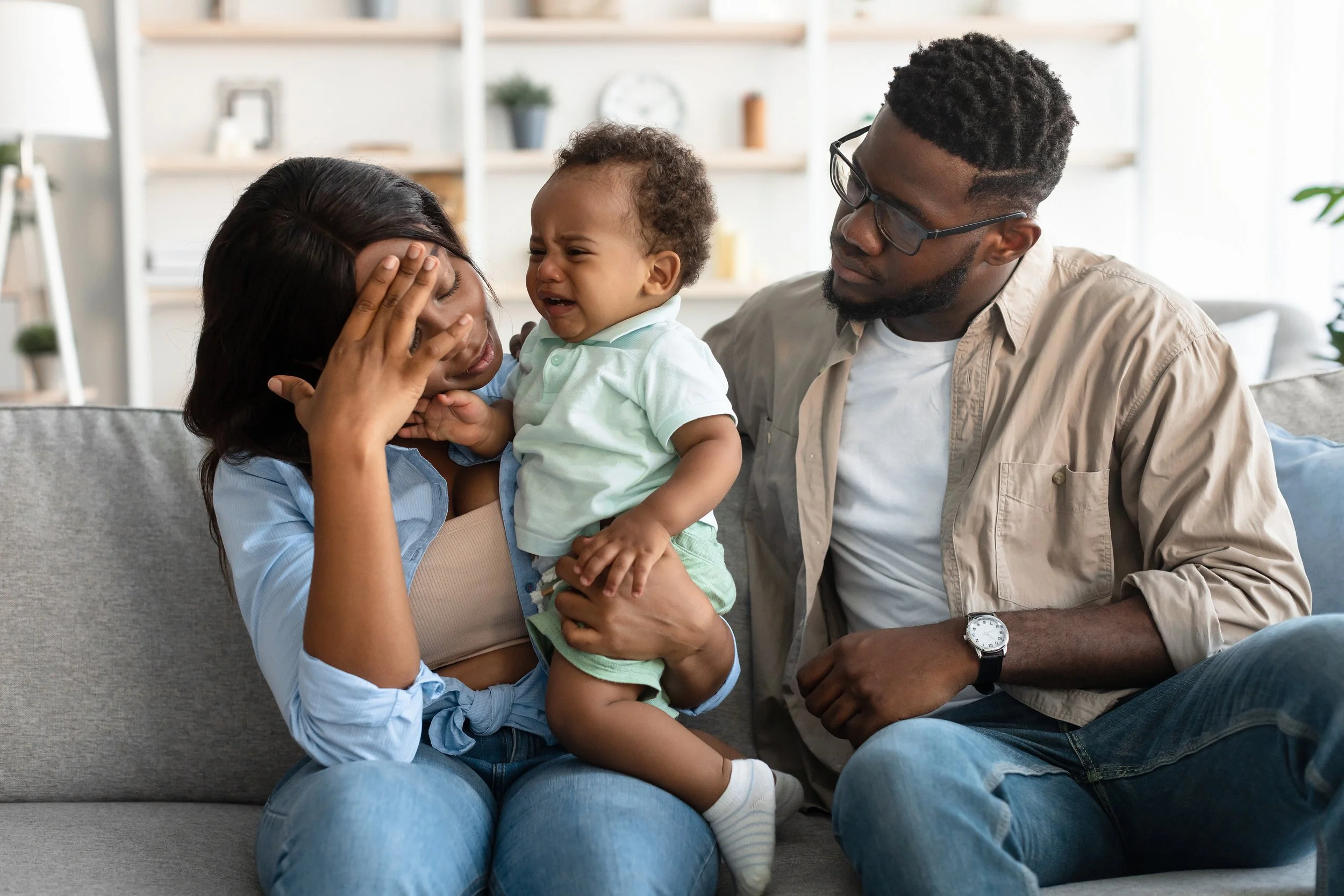
1. Do You Resent Your Partner Over Chores and Childcare?
Postpartum resentment builds in the gap between what one partner carries and what the other can see. It surfaces as arguments about dishes, bedtime, or a forgotten appointment. When the same complaint keeps returning and resolving nothing, the issue is the imbalance underneath rather than the task being argued about. What I watch happen is that one partner has been absorbing more than their share for weeks or months and has stopped saying so, because saying so hasn't changed anything. Underneath is usually shame. They love their baby. They love their partner. The resentment doesn't fit either of those facts, so it leaks out sideways instead of getting named. Couples who name it before it hardens into a fixed story about who their partner is move through this period with far less lasting damage. Resentment after a baby has a specific shape, and recognizing it early changes what happens next.
2. Are You Having the Same Fight Over and Over?
If you've had the same argument more than three times, you're fighting about the pattern rather than the topic. The content changes while the structure stays identical: one partner raises something, the other defends, the first escalates, the second withdraws, and nothing resolves.
The trigger stops mattering the moment the weight of every previous version enters the room. By then you're both responding to history instead of to what's actually in front of you.
Sleep deprivation makes this worse in a way that isn't a character flaw. A study that measured stress hormone levels found that couples who had gone a full night without sleep showed more stress and less warmth during a conflict conversation than couples who slept normally — direct evidence that poor sleep doesn't just correlate with worse fighting, it causes it. Two depleted people trying to resolve conflict are working against their own physiology.
3. Have Intimacy and Emotional Connection Disappeared?
Some decline in closeness is expected after a baby. What matters is whether it returns. Physical affection usually disappears before either partner decides they no longer want it, and the absence then gets read as rejection. Persistent disconnection with no sign of recovery is worth addressing directly.
Touching, hand-holding, leaning against each other on the couch: those go first, lost in the logistics. Then the absence starts carrying its own message. One person reads it as rejection. The other reads the first person's withdrawal as confirmation. Neither of them chose any of it.
Emotional disconnection follows a similar arc. You can share a house, coordinate a schedule, and manage a baby together while feeling completely alone in the same room. What I listen for is whether either of you still brings things to the other, or whether you've both started handling things by yourselves.
4. Has One of You Become the Default Parent?
The default parent is the one who wakes first, tracks the feeding schedule, holds the appointment calendar, and carries the running mental inventory of what the baby needs at any hour. The other partner helps without managing. The role forms through repetition until it becomes identity, usually before either person notices.
Sociologist Allison Daminger studied couples with young children and found that one partner disproportionately carries the anticipating and monitoring work — noticing what needs to happen and tracking whether it got done — while the other is more often credited with the visible decisions. The invisible half is the harder one to see and the harder one to hand off.
Nobody chooses this. By the time either of you sees it, it's been running for months. The one carrying everything is depleted and resentful. The one carrying less usually doesn't know what they're missing, because the information lives entirely in their partner's head. The default parent pattern describes how it forms and what it costs both people.
5. Do You Feel Like Roommates Instead of Partners?
Feeling like roommates after a baby means you function well together and hardly connect at all. Conversation runs on logistics: schedules, feedings, appointments. What stops is reaching for each other for any reason that isn't operational. The relationship didn't fail. It got deferred until deferring became the default.
This one is hard to name because nothing looks wrong. You're co-parenting well. You're kind to each other. What's gone is the partnership underneath, and its absence doesn't announce itself the way a fight does.
The phrase I hear most is some version of: we're good parents and terrible partners right now. That framing is accurate and worth taking seriously. Feeling like roommates after a baby has a mechanism underneath it that therapy addresses directly.
6. Is Postpartum Depression Affecting Your Relationship?
Postpartum depression changes the emotional environment both partners live inside. The person experiencing it feels unreachable. Their partner feels shut out and afraid of saying the wrong thing. Depression and relationship strain feed each other, and treating one while ignoring the other tends to stall.
What I see is a particular kind of loneliness running in both directions. Both people are accurate about their own experience. Neither can solve it from where they're standing, and the attempts usually leave each person feeling more alone than before they tried.
A 2026 study that followed 238 postpartum women over their first three months found that a drop in marital satisfaction predicted worsening depression, and worsening depression predicted a further drop in satisfaction — the two feed each other in a cycle that reinforces itself over time. Postpartum depression moves through a relationship in a specific way, and naming it is usually what unlocks the rest.
7. Do You Have No Time for Yourself Anymore?
Finding time for yourself is the single most common thing new parents fight about. Asking for an hour starts to feel like taking something from a partner who is equally depleted, so the asking stops. Both people then keep private track of who got a break, and it surfaces during unrelated arguments.
A 2026 What to Expect poll of 492 mothers found that 91% reported significant disagreements with their partner after having a baby, and the same share said the conflict affected their overall relationship. The most common sources were lack of personal time and communication breakdowns.
Couples who work this out stop treating time alone as a favor one person grants the other and start treating it as maintenance the household requires. That's a different conversation, and it usually needs a third person in the room to happen at all.

Should I See an Individual Postpartum Therapist or a Couples Therapist?
Individual perinatal treatment may need to be part of the plan when clinical symptoms are present. Couples therapy addresses what is happening between partners. Many people benefit from both, and choosing the right starting point matters, especially when clinical symptoms are present.
Individual perinatal treatment may need to be part of the plan when clinical symptoms are present.
Intrusive or frightening thoughts, persistent low mood, significant anxiety, obsessive checking, or the aftermath of a traumatic birth may require individual treatment focused specifically on those symptoms. Couples therapy can happen alongside that care when the symptoms are also affecting the relationship.
Couples therapy addresses what is happening between partners. Resentment, repeating conflict, withdrawal, changes in intimacy, unequal parenting load, and the relational effects of postpartum depression or anxiety all show up between two people. In my work with postpartum couples, my perinatal mental health training also informs how I understand what may be happening clinically and when additional individual support should be part of the treatment plan.
What I pay close attention to is what happens between partners when these moments occur: where the conversation changes, what each person begins assuming about the other, and what keeps the same interaction repeating. That's the level the Re|Pair™ framework works at, and it's information that only becomes visible with both people in the room.
Many couples need both, and the two can run alongside each other. When one partner is dealing with a diagnosable perinatal mood or anxiety disorder, individual treatment can address the symptoms while couples work addresses what those symptoms are doing to the relationship. Waiting for one to finish before starting the other usually means the relationship strain keeps accumulating in the meantime.
Couples come in stuck in a pattern neither of them can see from the inside. They leave able to name what's actually happening between them, and knowing what to do the next time it starts.Schedule a complimentary 20-minute consultation for postpartum couples counseling anywhere in Minnesota.
Frequently Asked Questions About Postpartum Couples Counseling
-
Couples therapy during the first baby is not only normal — it is one of the most practical things partners can do for their relationship. The transition into parenthood is one of the highest-stress periods a couple goes through, and most people go into it with no preparation for what it does to the relationship dynamic. Therapy gives both people a place to name what is shifting before the distance becomes harder to close.
-
Warning signs include persistent sadness or anxiety, emotional withdrawal, difficulty bonding with the baby, irritability that feels out of proportion, and increased conflict in the relationship. When these symptoms affect daily functioning or how you and your partner are connecting, speaking with a mental health professional is worth considering. Postpartum Support International offers free resources and a helpline at 1-800-944-4773 for individuals and couples navigating postpartum mental health challenges
-
Sessions focus on the pattern between you rather than relitigating specific arguments. That means identifying what actually happens in the moments things go wrong, what each person assumes the other means, and where the interaction turns. From there the work moves to division of labor, expectations neither of you said out loud, intimacy and rebuilding connection in ways that are realistic when both people are depleted. Sessions are virtual, which removes the childcare and travel problem entirely.
-
This comes up often, and how you raise it matters more than most people expect. Naming one specific, concrete problem tends to land better than a general statement about the relationship. "We keep having the same fight and I don't know how to get out of it" is easier to hear than "I think we need help." Offering a limited commitment helps too, something like trying a few sessions and reassessing. If your partner still won't come, individual work on the relational pattern can shift the dynamic enough that the conversation becomes possible later.
-
Couples therapy can address how postpartum depression or anxiety is affecting the relationship, including; communication, connection, caregiving, intimacy, and how each partner is responding to what is happening. When individual treatment is also indicated, the two forms of care can happen alongside each other.
-
It depends on the provider and your plan. Many insurance plans cover individual therapy but not couples therapy specifically, since couples therapy is not billed as treatment for a diagnosed condition. At ForwardUs Counseling, sessions are private pay. Many clients use HSA or FSA funds, or request a superbill to submit for potential out-of-network reimbursement. The best way to confirm your coverage is to call the member services number on your insurance card. description.
